 Business License

Benefits of a Secondary Fluidized Bed in a Calcium Chloride Spray Granulation Fluidized Bed Dryer
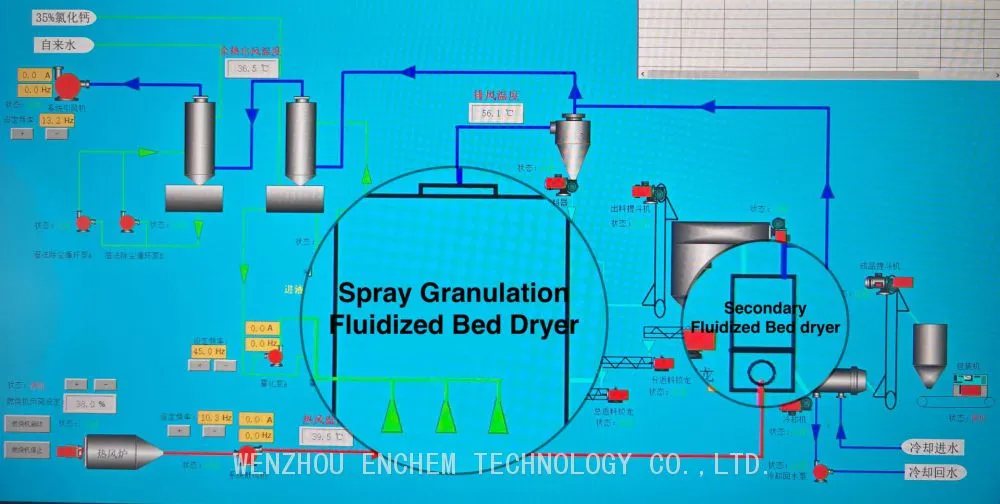
Unlike conventional calcium chloride spray granulation fluidized bed dryer systems, our process incorporates a secondary fluidized bed downstream of the primary spray granulation fluidized bed dryer. This additional drying stage separates the final drying process from the granulation process, providing substantial improvements in product quality, energy efficiency, capital investment, and operational reliability.
Improved Product Yield and Consistency
In a conventional single-stage spray granulation fluidized bed dryer, granulation and drying take place simultaneously within a single unit. After screening:
Approximately two-thirds of the product is rejected due to oversized or undersized particles and is recycled back to the granulation process.
Only approximately one-third of the product meets the particle size specification and proceeds directly to the cooling stage.
However, because the qualified product does not undergo an independent final drying step, its moisture content may still vary, resulting in inconsistent product quality.
By incorporating a secondary fluidized bed:
Only size-qualified product enters the second-stage dryer.
Final moisture content is precisely controlled before cooling.
Product quality and moisture uniformity are significantly improved.
Finished product consistency and production yield are enhanced.
Reduced Energy Consumption and Equipment Investment
In a conventional single-stage system, the primary fluidized bed dryer must provide sufficient drying capacity for the entire material stream, including both recycled material (approximately two-thirds) and qualified product (approximately one-third).
To ensure that all discharged material satisfies the required moisture specification, the main dryer typically requires:
A larger drying area and higher equipment capacity, increasing capital investment.
Higher drying temperatures, resulting in greater energy consumption.
Increased airflow, producing larger exhaust gas volumes and requiring larger dust collection and air handling systems.
With the addition of a secondary fluidized bed:
Only the qualified product (approximately one-third of the total material flow) requires final drying.
The primary dryer can be designed with lower drying intensity and a smaller capacity.
Overall heat demand and energy consumption are reduced.
Exhaust gas volume is significantly decreased.
Equipment size and total system investment are optimized.
Improved System Stability and Operational Reliability
In a conventional single-stage spray granulation fluidized bed dryer, achieving the required final moisture content often requires increasing the exhaust air temperature. While effective for drying, excessive exhaust temperatures can negatively affect the granulation process.
Drawbacks of High Exhaust Air Temperature
Reduced droplet adhesion during atomization, resulting in increased dust formation.
Excessive dust interferes with granule growth and lowers product yield.
Increased dust loading places greater demand on cyclone separators and wet scrubbers.
Higher system backpressure increases the risk of blockages and fouling.
More frequent cleaning and maintenance reduce equipment availability and production efficiency.
By introducing a secondary fluidized bed, the primary dryer no longer needs to achieve the final product moisture content independently. Consequently, it can operate at a lower exhaust air temperature, minimizing dust generation while maintaining efficient granulation.
The result is:
Improved process stability.
Reduced maintenance frequency.
Longer continuous operating periods.
Higher production efficiency and equipment availability.
Conclusion: A More Efficient And Sustainable Drying Solution
The integration of a secondary fluidized bed into the calcium chloride spray granulation process provides significant technical and economic advantages over conventional single-stage systems.
Higher Product Quality
Consistent final moisture content.
Improved product uniformity.
Higher finished product yield.
Lower Operating Costs
Reduced heat consumption.
Lower electricity and fuel requirements.
Smaller drying equipment and lower capital investment.
Enhanced Operational Reliability
Lower exhaust air temperatures.
Reduced dust generation and equipment fouling.
Fewer production interruptions and higher plant availability.
Improved Environmental Performance
Lower overall energy consumption and reduced carbon emissions.
Reduced exhaust gas volume.
Lower particulate emissions and reduced load on dust collection systems.
Overall, the two-stage spray granulation fluidized bed drying process delivers a more energy-efficient, reliable, and environmentally sustainable solution for the production of high-quality calcium chloride granules. By separating granulation from final drying, the process optimizes both product quality and operating economics, making it particularly well suited for modern large-scale chemical production facilities.
Recently Posted
-
Can MVR Evaporators Be Used for Calcium Chloride Concentration?
September 3, 2026Calcium Chloride Evaporation & Concentration SystemsCalcium chloride (CaCl₂) is widely used in industrial applications and is Read More
 -
MVR vs TVR: Efficiency, Cost, and Application Guide
September 2, 2026In the industrial evaporation field, energy-saving technologies have become critical for reducing operational costs and minimizing
Read More -
Successful Commissioning of the Potassium-Sodium Separation Four-Effect Evaporator
September 2, 2026OverviewWe are delighted to announce the successful commissioning of the Potassium–Sodium Separation Four-Effect Evaporator System
Read More -
OSLO Crystallizer – Efficient Fluidized Bed Design for Large Crystal Growth
September 2, 2026OverviewIn industrial crystallization processes, crystallizers are commonly classified according to their circulation mechanism an
Read More

Contact Us
Recommended Products
-
 Titanium Triple-effect Evaporator for Lithium Battery RecycleNegotiableMOQ: 1 Set
 -
Four-effect Falling Film Evaporator for Coffee Extract ConcentrationNegotiableMOQ: 1 Set
-
MVR Evaporator for Dyeing Wastewater TreatmentNegotiableMOQ: 1 Set
-
MVR Evaporator for Landfill Leachate TreatmentNegotiableMOQ: 1 Set
-
Triple-effect Forced Circulation Evaporator for Cobaltous Sulfate RecoveryNegotiableMOQ: 1 Set
-
Double-effect Countercurrent and Falling Film Evaporator for Caustic Soda ConcentrationNegotiableMOQ: 1 Plant
-
Double-effect Forced Circulation Evaporator for Calcium Chloride ConcentrationNegotiableMOQ: 1 Set
-
MVR Evaporator for Smelting Wastewater TreatmentNegotiableMOQ: 1 Set
-
Triple-effect Forced Circulation Evaporator for High Salinity Wastewater TreatmentNegotiableMOQ: 1 Set
-
Double-effect Central Circulation Evaporator for Metallurgy Effluent TreatmentNegotiableMOQ: 1 Set
-
Triple-effect Forced Circulation Evaporator for Mix Salt Wastewater TreatmentNegotiableMOQ: 1 Set
-
MVR Evaporator for Bio-pharmaceutical Wastewater TreatmentNegotiableMOQ: 1 Set
-
Calcium Chloride Solution Preparation and Refining PlantNegotiableMOQ: 1 Set
-
Vacuum Decompression Concentrator (Tank)NegotiableMOQ: 1 Set
-
Ammonium Sulfate Crystalline Powder Evaporation and Drying PlantNegotiableMOQ: 1 Set